Mac Machine Solutions is a machining consultant for manufacturers and machine shops of every size—large companies included. From Cleveland and across Northeast Ohio to remote support anywhere, we provide CNC programming help, quoting support, and CNC training that closes the gap between management teams and the shop floor, and keeps hard-won know-how in the building when experienced people retire.
Remote & On-SiteProgramming and support where you need it
Training That StaysKnowledge your team keeps
Quote-BasedClear scope, no surprises
Why Mac Machine Solutions
Bridge management and the shop floor.
Manufacturers of every size—from job shops to large companies—run into the same two problems: a gap between management teams and the shop floor, and hard-won knowledge walking out the door as experienced people retire.
Mac Machine Solutions bridges that gap. As a machining consultant serving shops across Northeast Ohio, including the Cleveland area, and manufacturers anywhere through remote support or travel on request, we help leadership and the floor work from the same understanding, solve the immediate problem, and keep the know-how in the building so performance does not leave with the people who built it.
We combine machining and engineering expertise with hands-on support to help manufacturers of every size improve performance, retain critical knowledge, and prepare their people for what comes next.
What We Do
Real solutions for manufacturers of every size.
CNC programming help, tooling guidance, process optimization, quoting support, and CNC training—plus easily editable program templates your team can keep using. Specialized support where programming, processes, quoting, tooling, and people intersect.
01 / CNC
CNC Programming & Optimization
Practical CNC programming help focused on clear, reliable, efficient shop-floor execution.
Programming assistance and troubleshooting
Program review and optimization
Process-aligned programming guidance
Easily editable program templates designed to your needs
02 / TOOLING
Tooling Guidance & Application
Make informed tooling decisions that fit the material, operation, machine, and people running the job.
Tool selection guidance
Application and process support
Practical problem-solving
03 / PROCESS
Process Optimization
Identify inefficiencies and strengthen the way work moves from setup to finished part.
Process review and improvement
Workflow and setup considerations
Continuous improvement support
04 / PLANNING
Quoting & Processing Support
Bring shop-floor realism to job estimating, quote development, and manufacturing process planning.
Practical job estimating support
Quote development assistance
Manufacturing process planning
05 / PEOPLE
Team Dynamic Training
CNC training and hands-on knowledge transfer through practical, implementation-focused workforce development.
Training shaped around shop needs
Hands-on knowledge transfer
Capability-building support
06 / PLACEMENT
Employee Placement Support
Help finding, assessing, and bringing on capable people—and preparing them to contribute quickly.
Finding capable people
Assessing skills and fit
Preparing new hires to contribute
YOUR SHOP / YOUR CHALLENGE
Not sure where to start?
A conversation about your operation can help identify where specialized support could make the biggest difference.
Our CNC training approach connects immediate technical solutions with long-term workforce capability.
01
Understand the Shop
Start with the actual challenge: equipment, people, programs, processes, and the knowledge already in place.
02
Develop Practical Solutions
Shape programming, tooling, processing, or training support around what the operation needs to accomplish.
03
Implement & Transfer
Support real-world application while helping people understand and sustain the improvements.
What Clients Say
Knowledge that stays with the team.
“Ken provides knowledge for my career, not just training for a particular piece.”
“When Ken came to work with us, I could confidently tell our customers we had the best team on the East Coast.”
Expertise should strengthen your operation long after the project ends.Request a Quote ↗
MAC
Ken MacasekFounder, Mac Machine Solutions
About the Founder
Technical depth. Personal commitment.
I started machining in 2008, making turbine shell castings. I learned from some of the top talent in the trade before the 2009 recession, when a lot of the workforce was near retiring and didn’t return with their knowledge. I gained, practiced, and refined their techniques and processes, along with an old-school, hard-working mentality.
I’ve worked in small mom-and-pop shops, where every dollar matters, and in bigger corporate-run companies, where the figures matter. That mix made me extremely skilled in tool use and selection, processing, and quoting. I’ve taken on leadership roles and leadership training, working on the floor and in the office, so I understand management and floor employees and the communication issues that arise.
I’m seasoned in mining equipment, gearboxes and gearing, vibratory hammers, oil and gas, aerospace, nuclear, and castings, in both job shop and production. Fixture design is part of that work. Hard-won knowledge is too valuable to lose. My work is to keep it in the shop and put it to use.
FounderKen Macasek
ExperienceIn machining since 2008 (18 years)
Industries ServedMining equipment, gearboxes and gearing, vibratory hammers, oil and gas, aerospace, nuclear
Shop-floor perspective
Engineering-informed thinking
Practical knowledge transfer
Flexible, focused support
“Ken is a change agent. They are not often appreciated by the people they are trying to help. I sincerely appreciate the approach you take in the difficulty in which change occurs.”
Proof of Work
Work you can see on the floor.
A look at setups, parts, and custom tools from the floor.
Project Stories
How the work actually got done.
Challenge, approach, and results from the floor. More stories will be added as they are ready.
In process: 12-inch round, first slot cutFinished part
Story 01
One setup, two parts, and a high-feed mill named Usain Bolt
Johnford Bridgemill, 94 in. × 154 in. vertical mill · Fanuc control
Challenge
Two parts from 12-inch round stock, finished to 8 in. × 8 in. at the widest points, with 2-inch-deep slots and radii in each corner.
The shop was not set up for rounds or for high-feed milling, and a dedicated slotting cutter was too expensive to justify for the work this shop typically runs.
A lot of metal had to come off, with a choice of whether to rough then finish, or go straight to the finish.
Hole drilling still had to be planned into the process.
Solution
A 2-inch high-feed mill was sourced instead of a slotting cutter.
The process used solid stops for repeatability and was programmed with subprograms: one simple setup, three rolls of the part, butting to the stops, with 0.05 in. left on all surfaces for movement.
Brackets were tack-welded onto the round for downward clamping pressure on operation one.
The high-feed mill ran at 325–350 surface feet per minute.
The final roll was planned so the part was oriented to drill holes and machine counterbores after the overalls were finished.
Results
15 hours1st part
10 hours2nd part
Operator training
The high-feed mill—which they named “Usain Bolt”—and high-feed milling techniques
Solid stops and locking in the workpiece
Helical milling
Insert drilling on a vertical mill without through-the-spindle coolant
Subprograms
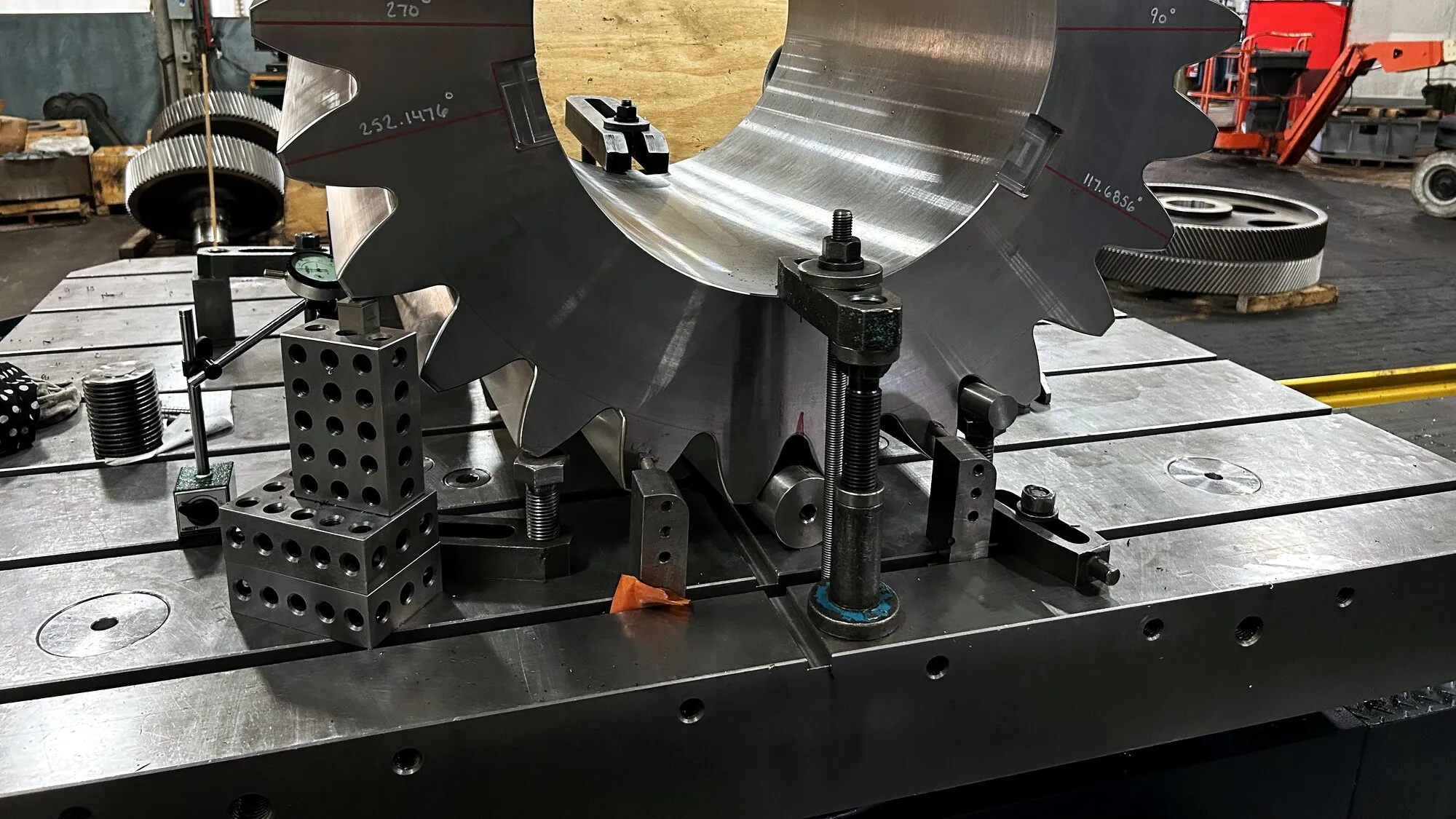
In process: setup on the Johnford horizontal boring millPrototype: helix and angles checked
Story 02
Taking the bull by the horns: gear teeth on a machine we already had
Johnford horizontal boring mill / rotary table · Fanuc control
In a world of “we’ve always done it that way” or “that won’t work,” sometimes you have to take the bull by the horns. When I stepped into my engineering role, this was my first—and most personal—challenge: to prove the machines we already had could cut gear teeth in a fraction of the time of the current process.
Challenge
MAAG cutting is a slow process—111 teeth takes 100+ hours.
A management attitude of “that won’t work” had to be changed.
Tooling had to be found that could form the teeth effectively.
Solution
All of the input data needed to produce rotation-over-axis movement was researched, defined, and calculated so the teeth would be formed at the correct helix angle.
The data was programmed into an easily editable format that runs in fewer than 20 lines of code.
The program was set up, run, and proved out while the machine had an open table.
Results
A prototype was produced with a proven program.
Helix and angles were checked and found to be correct.
Based on tool paths and time per tooth, the approach has the potential to cut MAAG tooth-forming time by 60–80%. Work with tool vendors is ongoing.
In process: indicating a tooth on the Johnford horizontal boring millSetup: fixture and table
Story 03
A documented, repeatable process for a job only one operator could run
Johnford horizontal boring mill / rotary table · Fanuc control
Challenge
The customer was asking for a lower price, so cycle times on the stand-up operation (part standing upright) needed to be cut.
The keyway had to be in line with the tooth space within 0.002 in. on the axial pitch.
The previous setup was inconsistent in timing the teeth.
Only one operator in the shop could run the job, and it ran on a machine that was unreliable.
The tooling in use was old and out of date.
Solution
Previous runs were reviewed and a plan was made for where the process could be improved.
Slower drills were replaced with inserted drills, making drilling about 3× faster.
Taps were replaced with thread mills, cutting tapping time in half.
Feeds and speeds were corrected to more modern, appropriate values.
Results
A repeatable process was documented in a binder so the method is preserved.
Multiple operators can understand the job, be trained on it, and suggest improvements.
The process can be repeated on multiple machines.
How Pricing Works
A conversation first. Then a custom quote.
Every engagement is scoped to what you actually need. You will know the work and the quote before anything begins—no surprises.
01
Start with a conversation
Every engagement begins with a conversation and an assessment of what is needed—time, training, and scope.
02
Receive a custom quote
From that assessment, you receive a quote shaped to the work, so the scope is clear before we begin.
03
Work the way you need
Programming is billed hourly based on part complexity. Remote support, on-site support in Northeast Ohio, and travel on request are all available.
FAQ
Questions shops usually ask.
A few straightforward answers about quoting, where we work, and how to get started.
How does quoting work?
Every engagement starts with a conversation and an assessment of what is needed—time, training, and scope. From there you receive a custom quote. Programming is billed hourly based on part complexity. You will know the scope and the quote before work begins, with no surprises. Rates are provided in the quote and are not listed on this site.
Do you work remotely or on-site?
Both. CNC programming help, quoting support, and much of the consulting can be done remotely. On-site support and CNC training are available in Northeast Ohio, including the Cleveland area, and travel to other locations is available upon request. Remote support is available anywhere.
What kinds of shops and manufacturers do you serve?
Mac Machine Solutions works with manufacturers and machine shops of every size—from job shops to large companies. The work is a fit wherever there is a gap between management teams and the shop floor, or a need for CNC programming help, quoting support, process improvement, or CNC training.
How does the training approach work?
Team Dynamic Training follows three steps: understand the shop, develop practical solutions, and implement and transfer. The goal is CNC training and knowledge transfer that stays with your team—building internal capability, not long-term dependency.
What should I send when I request a quote?
Use the Request a Quote form and describe the challenge, your operation or equipment, and what a successful outcome would look like. A part drawing or photo (PDF, image, DXF, or STEP) is helpful but optional. If you are not sure where to start, say so—that is enough to begin the conversation.
Where is Mac Machine Solutions based, and where do you work?
Mac Machine Solutions is based in Cleveland, Ohio. On-site work is focused on Northeast Ohio, with travel available upon request. Remote CNC programming help, quoting support, and machining consulting are available anywhere.
Request a Quote
Tell us about the work.
Share a little about your shop, the challenge, and what you need—CNC programming help, quoting support, CNC training, or something you are still sorting out. We will follow up to assess scope and send a custom quote.
Service area: Northeast Ohio on-site · Travel available upon request · Remote support anywhere
Serving manufacturers and machine shops of every size with practical, project-focused support.
CNC programming, program templates, tooling, process optimization, quoting support, Team Dynamic Training, and employee placement support.
Thank you. We received your request.
Mac Machine Solutions will review what you sent and follow up using your preferred contact method. If you need to add a drawing or details, just send another request or email mac@macmachinesolutions.com.